“Who can make six different Ploussards from five different terroirs in Pupillin, the world capital for the grape? So far, only the young Benjamin Benoit from Cellier Saint-Benoit.” – Luis Gutierrez, The Wine Advocate
Benjamin Benoit farms 6.25 hectares of vines in the village of Pupillin, just south of Arbois. The vines have been in his family for generations and the fruit was sold to the local co-operative until his father produced domaine bottling of Vin Jaune in the 2002 vintage, leaving the co-op entirely in 2004. Benjamin took over the domaine in 2019 – aged just 23 – and fast established himself as a rising star; just two years later he was named as the Guide Hachette’s Winemaker of the Year.
This wasn’t just luck: studies of viticulture and winemaking in Beaune were followed by internships with Charles Lachaux, Amélie Berthaut and Nicolas Faure followed, as did a vintage in Marlborough. Decades of experience may not be on his side, but a rare talent, dedication, love of hard work and a voracious pursuit for quality has already launched him into the top tier of Jura names to know. Since 2019, he has been transitioning vineyards to organic and regenerative practices and in the cellar he prefers indigenous yeasts and old oak barrels for ageing. He produces wines in the ouillé or topped up style, which results in Chardonnays that are bright, clean and with lots of freshness.
As well as whites made from both Chardonnay and Savagnin, there are no less than six site-specific Ploussards produced, all which show a characteristic pale colour and a fine-boned but persistent presence and delicate, lacey tannins. Production is understandably on the low side – a few thousand bottles of any wine at the most.
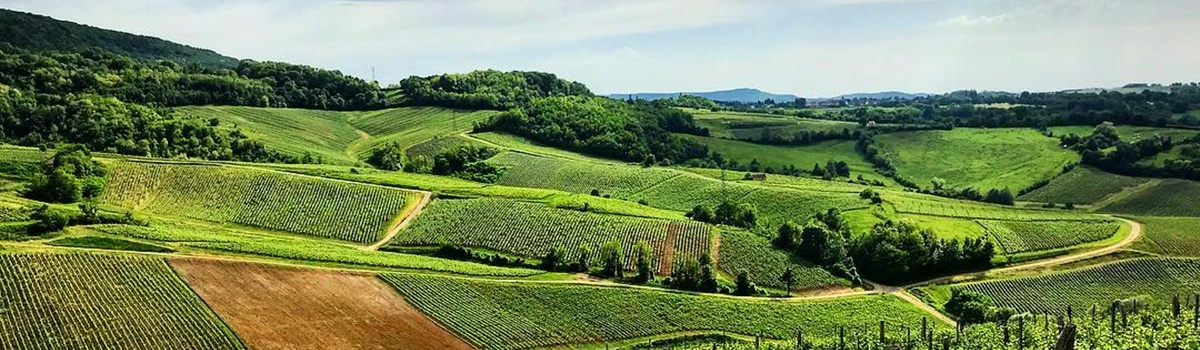
Côte de Feule is arguably the most famous site in Arbois sitting at around 400 metres elevation on ancient marl soils with a high proportion of limestone fossils.
Chambines tends to be the palest of the bunch, hailing from their youngest vines planted on shallow stony soils with a high proportion of clay and marl.
Le Grapiot is a small lieu-dit that sits on a geological fault where two different soil types meet in the northern part of the appellation on a steep, north-facing site.
La Ronde offers a little more density and ‘grunt’ with red marl soils, around 340 metres above sea level in the northern part of the appellation.
Viandris is a cooler site that is home to Cellier Saint Benoit’s oldest vines planted in the 1930s. Only around a thousand bottles are ever made each year, with approximately 0.20 ha planted to Ploussard and Chardonnay, as well as a few rows of Melon à Queue Rouge, an ancient Jura mutation of Chardonnay with red stems.
Courbes Raies is a 0.5 hectare plot, situated on a west-facing slope of Triassic limestone with a narrow band of of grey marl, planted in 1957 and 1984.


